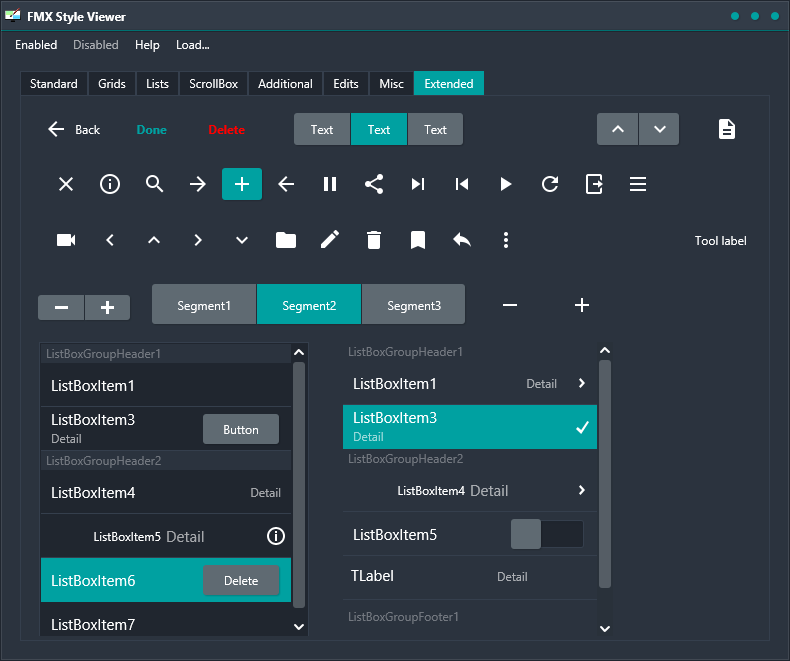
Delphi Firemonkey Styles
воскресенье 17 февраля admin 71
There are a number of ways to store and access styles. In this section I shall look at each in turn, and in order of preference. System Styles System styles are those designed to look like a given operating system. They are stored as resources in your final application and are not (easily) available for browsing and editing. Unless they are overridden then the appropriate style for the current platform will be selected from the list below. Resource Name Platform win7style Windows 7 win8style Windows 8 lionstyle OS X lion2xstyle OS X with retina display ipadstyle iPad prior to iOS7 iphonestyle iPhone other than version 6 (XE4) or prior to iOS7 iphonestyle_6 iPhone 6 (XE4 only) iphonepadstyle_Modern iOS7 androidstyle Android (You can see the names of the system styles for the current platform in the source of GetSystemStyle in the unit FMX.Controls. The system style can be accessed via the SystemStyle or SystemStyleHiRes properties of which return the style appropriate for the platform.
Fortunately the format of the styles used by FireMonkey is stored in a human readable format very similar to our old dfm format (Delphi forms), this allows us to understand how FireMonkey store, read and use these styles and of course make cool stuff with this. Beyond these styles registered Delphi XE5 users can also download and use 'premium' styles that are available as a separate download ('FireMonkey XE5 Premium Style Pack Is Now Available'). This will add 'Jet' and 'Diamond' styles for both Android and iOS to the mix.
These properties are read only and their value is determined by FireMonkey. ActiveStyle The currently active style is stored in another pair of properties of, ActiveStyle and ActiveStyleHiRes.
By default these will be the same as the SystemStyle/SystemStyleHiRes properties but they can be modified by calling TStyleManager.SetStyleFromFile or TStyleManager.SetStyleFromFileHiRes and passing in the name of a style file. Alternatively, you can use one of the LoadXXXX methods of TStyleManager and assign the result to ActiveStyle or ActiveStyleHiRes. Setting the active style will set the style for the entire application (unless you use one of the methods below to override it for a specific form or forms). This is the preferred method to use to modify the look of an entire application. These methods should be called from your project (dpr) file before Application.Initialize is called, or from the initialization section of a unit. If called later, e.g from a forms OnCreate event handler, you may find that the app is initialized with the default style and then updated with your new style. You can view the project file with the Project/View Source menu item in Delphi.
Here is a sample loading a custom style.
Go Up to FireMonkey controls are arrangements of a tree composed of subcontrols, primitive shapes, and brushes, decorated with effects. These compositions are defined as styles, stored in a style book. The individual elements of a style are internally called resources; because that term has several other meanings, the term style-resource is used for clarity. Styles provide a great deal of customizations without subclassing. The FireMonkey styles that are provided with the product are saved in.Style files located in C: Program Files (x86) Embarcadero Studio 20.0 Redist styles Fmx.
You can load these styles with. • Right-click the needed control and select Edit Default Style. 
After you click Edit Default Style, the empty is created if there was no StyleBook on the form. • In the Structure pane, select the component of the control that you want to change. • Do the needed edits, save them, and close the view. Now the StyleBook that was initially created contains all your changes. • To see your edits, double-click the StyleContainer. For example, the default style of is defined simply as: • panelstyle: TRectangle The name of the style-resource that defines the style is 'panelstyle'. It refers to a.
The appearance of this rectangle can be changed in the Style Designer, and then every TPanel on the form will have that appearance by default. However, there is no rule that a TPanel must be represented by a TRectangle.
A or would work. Even simple controls can be a complex composition. Object TBrushObject StyleName = 'somebrush' end Note: After you add a new platform or change the current platform, FireMonkey automatically recreates the custom style for the target control. Nested Styles Styles may refer to other styled components. As always, styles are found by their top-level names in the TStyleBook. For example, to use the same gradient: • In the FireMonkey Style Designer, save the existing styles in a.style file.