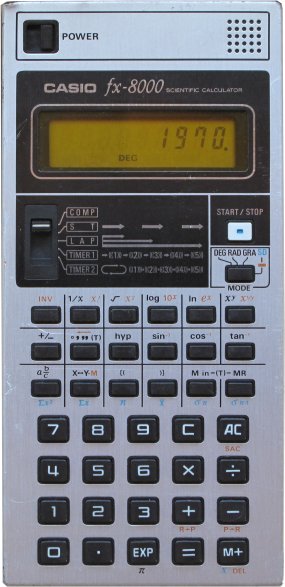
Casio Fx 7000g Manual Pdf
понедельник 25 февраля admin 16
Fx-7400G Manual. BEFORE USING THE CALCULATOR FOR THE FIRST TIME. Portable Document Format (PDF) documents can be read with Adobe.
Electronic Calculators By 1961, transistors had gained a foothold in business systems. The first minicomputers had started to appear on the market, and the first fully electronic desktop calculators, the Sumlock ANITA Mk VII and Mk VIII, were introduced. Transistors were very expensive in 1961, so Sumlock opted to use miniature thyratrons as the switching elements in the ANITA. The ANITA was capable of performing addition, subtraction, multiplication and division, and used a Comptometer-style input system and Nixie tube readout. By the mid-1960s, Japan had introduced transistorized desktop calculators, and would soon be producing machines built on discrete bipolar and MOS logic.
In 1964, a small company named Mathatronics completed development of the Mathatron, the first electronic programmable desktop calculator. Introduced more than a year before the more well-known Olivetti Programma 101, the Mathatron used full algebraic entry, complete with parentheses. The Mathatron featured an unusual 'ticker tape' style printer, whose output doubled as a single-line display.
Texas Instruments foreshadowed the rapidly approaching handheld calculator market in 1967, with the announcement of the experimental 'Cal-Tech' calculator. Like the aforementioned Mathatron, the Cal-Tech made use of ticker tape style printer which doubled as a display. Unlike the Mathatron printer, which utilized a conventional impact mechanism, the Cal-Tech's printer employed TI's new thermal printing technology. In 1968, Hewlett-Packard introduced the 9100A, the world's first desktop programmable scientific calculator. The 9100A featured discrete diode and transistor logic, RPN entry, and used the famed CORDIC algorithm to compute transcendental functions.
The success of the 9100A lead directly to the development of HP's powerful 9800-series desktop instrumentation control calculators, as well as their personal calculator product line. In 1970, MOS LSI technology became available for calculator products. Several manufacturers introduced large LSI-based handheld calculators, distinctively larger than a pocket calculator but handheld nonetheless. Sharp introduced the EL-8, based on a four-chip Rockwell chipset and Iseden Itron VFDs.
Klyuch aktivacii matlab 2010. Canon introduced the Pocketronic, a commercialization of the original TI Cal-Tech design, with a three-chip TI chipset and ticker tape printer/display. In 1971, Mostek introduced the MK6010 single-chip calculator, and Bowmar entered the market with the 901B 'Brain', a truly pocket-sized handheld calculator with a TI single-chip calculator LSI and compact Bowmar Opto-Stic LED display. Over the next two years, dozens of companies leapt into a brutal fight for dominance in an explosive new handheld calculator market, armed with LSI chipsets and single-chip calculators manufactured primarily by TI, AMI, Mostek, Rockwell and various Japanese manufacturers. In 1972, TI began in-house calculator production with the TI-2500 Datamath four-function handheld calculator. The Datamath used a TMS0110 single-chip calculator, similar to chips and small chipsets they had previously sold to other calculator vendors.
Success Intermediate Teacher's Book New Edition for DVD-ROM Pack. $27.81 $ 27 81. Temporarily out of stock. Order now and we'll deliver when available. Teacher success story.
Just a few months later, HP introduced the HP-35, the world's first handheld scientific calculator. The HP-35 originated in a demand made by Bill Hewlett several years earlier, for a pocket-sized version of the 9100A. The HP-35 used a two-chip PMOS CPU, designed by HP and fabricated by Mostek and AMI. The introduction of the HP-35 brought about the end of the slide rule era. College curricula previously centered around the use of traditional logarithmic slide rules were quickly rewritten to make use of the new 'electronic slide rules', although some institutions maintained a ban on calculators into the 1980s. The TI-2500, HP-35 and their many successors captured almost all of the US calculator industry.
Canon, Casio and Sharp secured most the Japanese industry, and the calculator wars came to an end. These survivors would set the tone of the US calculator market for the next 40 years: TI would dominate the lower end student and general consumer customer base (with the Japanese manufacturers constantly nipping at their heels), while HP would enjoy a mostly uncontested monopoly of the professional scientific, engineering and financial calculator market sectors.